
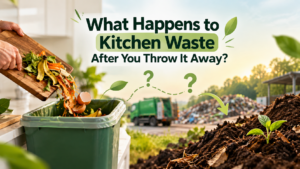
 Every day, we throw away things like vegetable peels, fruit scraps, leftover food and tea waste without giving much thought to what happens next. Once the kitchen bin is emptied, the waste is out of our sight. But it still has to go somewhere.
For most of us, throwing something away feels like the end of the story. In reality, it is only the beginning of its journey.
The way we handle kitchen waste can make a big difference. When organic waste is mixed with plastic and other household waste, it becomes difficult to recover or reuse. When it is separated and managed properly, the same waste can be turned into something useful.
Where Does Your Kitchen Waste Go?
Once your kitchen waste leaves your home, it is collected and transported for further treatment or disposal.
If wet waste has been separated properly, it can be sent for organic waste management, composting or other suitable processing methods. But when everything goes into the same bin, food waste gets mixed with plastic, paper, glass and other materials.
Think about a leftover piece of food sitting inside a garbage bag with plastic wrappers and bottles. By the time it reaches a waste processing facility, separating everything becomes much more difficult.
This is why source segregation matters.
A simple habit of keeping wet and dry waste separate can make the entire waste management process easier.
What Happens When Kitchen Waste Goes to a Landfill?
A lot of household waste eventually ends up in landfills. Food waste does not simply sit there forever. It decomposes over time.
The problem is that landfills are not designed specifically for composting organic waste. When organic material breaks down in conditions with limited oxygen, it can produce methane and other gases.
At the same time, landfills require large areas of land and continuous management.
So instead of sending valuable organic material away as garbage, why not process it where it is produced?
This is where kitchen waste composting can make a difference.
Your Kitchen Waste Can Become Compost
Composting is actually a very natural process.
Microorganisms such as bacteria and fungi break down organic material and turn it into compost. The same process happens in nature when leaves and other organic matter slowly decompose.
The difference is that composting allows us to manage this process in a controlled way.
Vegetable peels, fruit waste, food scraps and other suitable biodegradable materials can be processed and eventually turned into compost from food waste.
What started as something you were about to throw away can become something useful for your plants and soil.
How Does Kitchen Waste Composting Work?
The basic idea behind food waste composting is quite simple.
First, suitable organic waste is separated from other household waste. It is then placed into a composting bin or kitchen waste composting machine.
For decomposition to happen properly, the compost needs suitable moisture and airflow. Depending on the method being used, the material may also need to be mixed or aerated.
Over time, microorganisms break down the organic matter. The food scraps gradually lose their original form and become dark, crumbly compost.
The finished compost can then be added to soil, gardens and plant pots.
So instead of asking, “Where can I throw this away?” we can start asking, “Can I put this back into the soil?”
What Can You Compost?
A large part of our everyday kitchen waste is organic and can be composted.
This can include:
• Vegetable peels
• Fruit scraps
• Leftover food
• Tea waste
• Other suitable biodegradable kitchen waste
Plastic, glass, metal and other non biodegradable materials should not be added to a composting system.
This is why good kitchen waste management starts right in the kitchen. Separating your waste correctly makes everything that follows much easier.
Can You Compost at Home?
You do not need a huge garden to start home composting.
Traditional composting can be done using a suitable bin or composting setup. But for people living in apartments or homes where space is limited, a home composting machine can be a more convenient option.
A composting machine for home gives you a dedicated place to process your kitchen waste instead of sending it out with the rest of your household garbage.
The right solution depends on how much waste your household generates, how much space you have and how much daily effort you want to put into composting.
What About Apartment Waste?
Managing waste becomes a little different when you live in an apartment.
One building can have hundreds of people generating kitchen waste every day. If all of that wet waste is simply collected and transported elsewhere, the quantity can quickly add up.
This is where wet waste management for apartments becomes important.
Apartment communities can collect their organic waste separately and explore ways to process it within the premises. A suitable composting machine for apartments can help communities manage their wet waste closer to where it is generated.
Instead of truckloads of organic waste leaving the community every day, some of that waste can be processed and converted into compost.
What About Offices, Hotels and Institutions?
The same idea applies to places such as hotels, offices, schools and other institutions.
These locations can generate a considerable amount of food and organic waste every day. For them, bulk organic waste management becomes an important part of responsible waste handling.
Depending on the quantity of waste, organisations can explore on site wet waste management solutions that allow organic waste to be processed closer to its source.
It is a simple shift in thinking. Rather than seeing organic waste only as something that needs to be transported away, it can be treated as a resource that can be processed locally.
What Happens to the Compost?
This is where the story gets interesting.
The waste that started as vegetable peels, fruit scraps and food leftovers can eventually become compost that goes back into the soil.
Finished compost can be used around plants, in gardens and in pots. It adds organic matter to the soil and can help improve soil structure and moisture retention.
For someone growing plants at home, this creates a simple cycle.
Food → Waste → Compost → Soil → Plants
Some composting systems can also produce a liquid output during the process. Depending on the system, this may be collected separately and used according to the manufacturer’s instructions.
Where Does DOSTBin Come In?
This is the idea behind DOSTBin.
Instead of treating kitchen waste as something that simply needs to leave your home or premises, DOSTBin provides a way to process organic waste closer to where it is generated.
For households, DOSTBin offers compact solutions designed for regular kitchen waste. DOSTBin Popular provides a simple manual option, while DOSTBin Premium provides a fully motorised and app enabled system with automated aeration cycles.
For apartments, offices, institutions and other larger waste generators, DOSTBin also offers solutions designed to handle larger quantities of organic waste.
The goal is not complicated.
Keep organic waste separate. Process it properly. Turn it into something useful.
It Starts With One Kitchen Bin
We often think of waste management as something that happens after the garbage truck arrives. But better waste management actually starts much earlier.
It starts when you are standing in your kitchen with a vegetable peel in your hand and deciding which bin it belongs in.
That small decision determines what happens next.
It can become part of a mixed waste stream that ends up in a landfill. Or, when separated properly, it can become part of a composting process and eventually return to the soil.
That is the real opportunity with kitchen waste management.
Our kitchen waste does not have to be the end of something. With the right approach to wet waste management, it can become the beginning of something useful.
By Mimansha Mishra